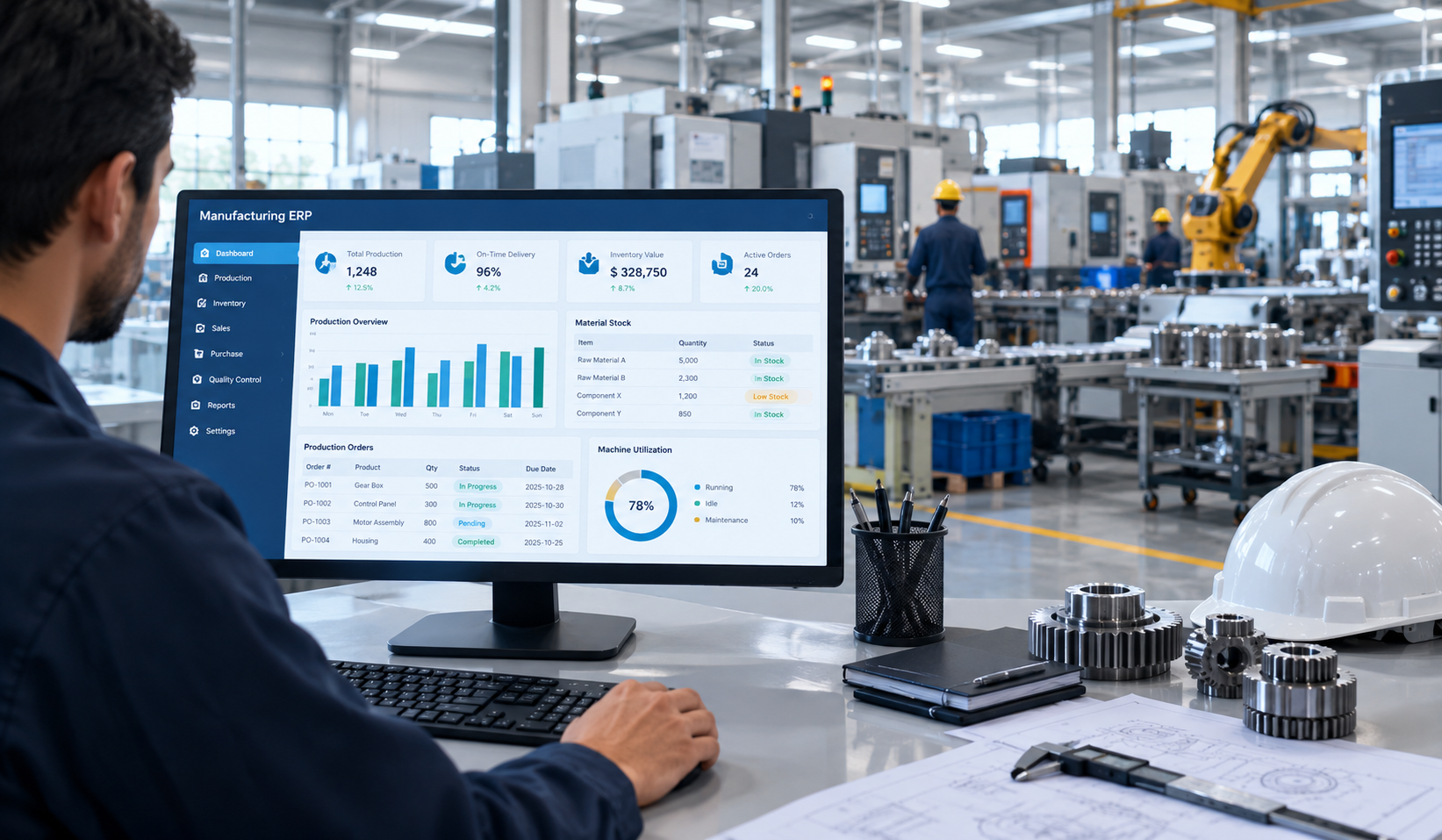
The best manufacturing ERP software is the one that fits your production model (discrete, process, make-to-order or make-to-stock), connects production, inventory, purchasing, costing and finance in one system, and supports UAE VAT and e-invoicing with local implementation help. Choose it by asking “can it run the way our factory actually operates?” — not “which ERP has the most features?”
A manufacturer in Dubai, Sharjah, Abu Dhabi or a free zone such as JAFZA or KIZAD may run several warehouses, suppliers, production processes and customer orders from one operation. When those sit in spreadsheets and disconnected applications, management cannot see what is being produced, what materials are available, what production really costs, or where problems start. Below are the seven features that separate a manufacturing ERP from a basic accounting system, two quick tools to test your own numbers, the UAE-specific points most generic guides skip, and a ten-question checklist to use in any vendor demo.
What is the Best ERP Software for Manufacturing?
The best ERP software for manufacturing is one that fits the company’s production model, operational complexity, inventory requirements and growth plans. Manufacturing ERP systems bring production planning, inventory, purchasing, costing and financial information together. Industry guides also separate different environments — discrete, process, make-to-order and mixed-mode production — and a system built for one can struggle with another.
Don’t ask “Which ERP has the most features?” Ask “Which ERP can manage the way our factory actually operates?”
That one change of question decides most ERP implementations before a contract is signed.
Why Manufacturers Need More Than a Basic Accounting or Inventory System
A standard accounting or inventory system records purchases and sales. Manufacturing adds another layer: how raw material becomes finished goods, and what that conversion costs. When each step lives in a separate file, visibility breaks at every hand-off:
Purchasing
Buyers check several spreadsheets before ordering.
xRaw materials
Stock by warehouse is unclear or outdated.
xProduction
Work orders start without confirmed material.
xWork-in-progress
Wastage and stage costs go unrecorded.
xFinished goods
Sales promise stock that is not there.
xUnknown cost
Finance cannot say what each batch cost.
× = information lost between departments when systems are disconnected.
A factory may need to manage all of the following in one place:
Raw materials
Bill of Materials
Production orders
Work orders
Production stages
Machines & equipment
Labour
Work-in-progress
Finished goods
Wastage
Batch production
Warehouse movements
Production costing
Quality information
Supplier purchasing
Customer orders
A manufacturing ERP creates one connected operational environment where this information moves between departments instead of being maintained separately.
What the same line looks like in one system
Material
requirement
Demand and BOM show what is needed.
Purchase
Request, quotation, order, receipt.
Inventory
Stock visible by warehouse.
Production
Work orders, stages, machines.
Sales & delivery
Finished goods to customer orders.
Finance & reports
Cost, margin and VAT-ready invoices.
Test Your Own Numbers in Two Minutes
Production volume alone does not determine profitability. Production cost = material cost + labour + machine or process cost + wastage + other production expenses. Enter one recent batch below, then score how connected your current systems really are. Everything runs in your browser — nothing is sent or stored.
1. Production Cost & Margin Check
One batch, in AED. Use good units that passed to finished goods.
Margin is 15.0% before overheads. The question is whether your current system can produce this per batch without a spreadsheet.
See Process-Wise Costing in RealSoft2. ERP Fit Scorecard
Tick what your current systems can do today, without manual re-entry.
Mostly disconnected. Production, stock and cost are probably reconciled by hand. A manufacturing ERP would replace several spreadsheets at once.
Book a Gap Review DemoSimplified illustrations for planning only. The cost check excludes VAT, overheads not entered above and any standard-costing adjustments. The scorecard is a conversation starter, not an audit.
7 Features to Look for in Best Manufacturing ERP Software
Use these seven as your evaluation frame. For each one, ask the vendor to show it working on your own product, not describe it on a slide.
Production Planning and Scheduling
Production planning sits at the centre of the factory. The ERP should plan production against customer demand, available materials, capacity and delivery dates, giving production managers a clear view before work reaches the floor. It should show:
- Production schedules
- Production stages
- Delays and bottlenecks
- Work orders
- Machine allocation
- Material availability
- Production status
Ask in the demo: “Create a work order and show me whether the materials are available.”
Bill of Materials and Production Processes
The system must define how a product is made. This matters most when a product has several components or production stages. Look for:
- Bill of Materials
- Routings
- By-products
- Recipes and formulas
- Material requirements
- Production quantities
- Production processes
- Wastage
Inventory and Material Management
Production stops when materials are missing. Manufacturing inventory should cover raw materials, work-in-progress and finished goods and answer these questions without a phone call:
- What is available now?
- Where is the stock located?
- What is reserved for production?
- How much finished stock exists?
- What needs to be purchased?
- Which items move slowly?
Production Costing
Manufacturers need the cost of each product, batch or process, not only the volume produced. A manufacturing ERP brings the cost elements together for pricing, budgeting and profitability analysis:
Ask in the demo: “Show the cost of one finished batch, line by line.”
Purchasing and Supplier Management
Production depends on reliable material supply. Purchasing should be driven by material requirements and linked to inventory and production, so buyers stop checking spreadsheets before every order:
Machine and Equipment Management
Machines are valuable assets, and unexpected downtime hits delivery dates and operating cost. The ERP should connect equipment records with maintenance and production:
- Asset records
- Maintenance costs
- Corrective maintenance
- Maintenance schedules
- Machine allocation
- Equipment history
- Preventive maintenance
Dashboards and Manufacturing Reports
Management needs current information, not only historical reports. Modern manufacturing ERP increasingly combines operational data with dashboards, analytics and decision support. A useful dashboard monitors:
- Production progress
- Production costs
- Purchasing
- Inventory position
- Wastage
- Sales
- Material shortages
- Machine utilisation
- Financial performance
Manufacturing ERP Software for Different Production Models
No single production model fits every manufacturer, so evaluate an ERP against your actual model rather than comparing feature lists.
Discrete manufacturing
Individual products or assemblies. Needs BOMs, routings and component tracking.
Machinery · equipment · hardware · industrial products · components
Process manufacturing
Formulas, recipes, batches or continuous processes. Needs formula control, batch scaling and wastage tracking.
Food · sweets and chocolates · chemicals · packaging materials
Make-to-order
Production starts after the customer order. The ERP must link sales orders to production planning, material requirements and delivery dates.
Fabrication · custom products
Make-to-stock
Production follows anticipated demand and builds finished inventory. Inventory forecasting and production planning matter most.
Packaged goods · standard products
What Should UAE Manufacturers Consider When Choosing an ERP?
Selecting manufacturing ERP in the UAE involves more than production functionality. Most generic “top 10” lists skip these six points:
Integrated finance
Production costs should flow into accounting and financial reporting rather than living in a separate file.
Inventory across locations
Several warehouses need visibility of stock movements and availability.
Tax and invoicing
Workflows should support UAE VAT, Corporate Tax records and the e-invoicing mandate below.
Cloud accessibility
Authorised users can reach business information from different locations and devices.
Scalability
The system should absorb more products, warehouses, users, companies and production requirements.
Local implementation support
Success depends on configuration, training and ongoing support, not only software functionality.
UAE e-invoicing: the dates a manufacturer should know
The UAE is introducing mandatory electronic invoicing for B2B and B2G transactions through Accredited Service Providers (ASPs) on a Peppol-based model. Invoices must be structured data, and failing to appoint an ASP and implement on time carries a fine of AED 5,000 per month. Your ERP must be able to issue compliant e-invoices or integrate with your ASP.
Business group | Appoint ASP by | Go-live |
|---|---|---|
Annual revenue AED 50 million or more | 30 October 2026 (extended from 31 July 2026) | 1 January 2027 |
Other businesses | 31 March 2027 | 1 July 2027 |
Government entities | 31 March 2027 | 1 October 2027 |
What Should UAE Manufacturers Consider When Choosing an ERP?
Many manufacturers outgrow accounting software but buy a generic ERP that still cannot model a production process. Compare the type of system before you compare vendors.
Capability | Accounting / inventory software | Manufacturing ERP |
|---|---|---|
Records purchases and sales | Yes | Yes, linked to production |
BOMs, formulas, recipes, routings | Usually not | Core function |
Production and work orders | No | Yes, with material check |
Raw materials, WIP and finished goods | Finished stock only | All three, by warehouse |
Batch or process-wise costing | Manual, in spreadsheets | Built into production |
Machine and maintenance link | No | Assets and maintenance connected |
Finance sees production cost | After manual journal entry | Directly from production |
What Should UAE Manufacturers Consider When Choosing an ERP?
These questions are more useful than picking the ERP with the longest feature list. Ask every vendor to demonstrate each answer.
1. Does it support our manufacturing model?
Discrete, process, make-to-order or make-to-stock.
2. Can it manage BOMs, formulas, routings and processes?
Multi-level products and recipes should be easy to maintain.
3. Does production use real-time inventory?
Material availability should show before work starts.
4. Can purchasing respond to material requirements?
Shortages should become purchase requests.
5. Can we calculate production cost accurately?
Material, labour, machine, wastage and other expenses.
6. Can we monitor machines and maintenance?
Downtime and servicing affect delivery.
7. Can finance access production costs?
No separate re-keying into accounts.
8. Can management see dashboards and reports?
Production, stock, cost and sales in one view.
9. Can it support multiple warehouses or companies?
Stock and costs should stay clear across locations.
10. Can it scale, and handle UAE e-invoicing?
More users, products and companies, plus compliant invoices.
So, Which Is the Best ERP Software for Manufacturing?
There is no universal ERP that is automatically right for every manufacturer. The best one matches your production model, inventory structure, costing requirements, business size and future growth. For UAE manufacturers, the decision should also weigh local requirements, implementation support, integration, and the ability to connect manufacturing with finance, purchasing, sales and inventory.
Above all, a manufacturing ERP should give better control over the complete production lifecycle — from raw material purchasing to production, inventory, costing, sales and financial reporting.
RealSoft ERP for Manufacturing Businesses
RealSoft Manufacturing ERP from Coral Business Solutions — backed by 23+ years in the UAE and 5,000+ implementations — connects manufacturing operations with the wider business. The platform brings together:
- Production
- Sales
- Assets & Equipment
- E-Invoicing
- Inventory
- Warehouse management
- Facility Maintenance
- Reporting
- Purchasing
- Finance & Accounts
- HR & Payroll
- Cloud ERP
Manufacturing functionality includes production processes, formulas and recipes, BOM/BOQ, routing maintenance, batch processing, machine allocation, process-wise costing and production reporting. RealSoft also offers manufacturing-specific solutions for fabrication, packaging materials, hardware and tools, sweets and chocolates, bakery, process manufacturing and discrete manufacturing, and states that the manufacturing module can be customised around a company’s formulas and production procedures.
Coral positions the platform for manufacturers dealing with downtime, stock availability, productivity and operational visibility. Explore RealSoft Manufacturing ERP to see how production, materials, inventory, costing, purchasing, finance and reporting work in one connected platform.
Frequently Asked Questions
What is manufacturing ERP software?
Manufacturing ERP software is an integrated business system that manages production together with inventory, purchasing, sales, finance, costing and warehouse operations, so every department works from the same data.
What is the best ERP software for manufacturing in the UAE?
There is no single best ERP for every manufacturer. The best one matches your production model (discrete, process, make-to-order or make-to-stock), inventory structure, costing needs and growth plans, and supports UAE VAT, e-invoicing and local implementation support.
What features should manufacturing ERP software have?
Key capabilities are production planning and scheduling, Bill of Materials and routing management, inventory across warehouses, production costing, purchasing and supplier management, equipment and maintenance management, financial integration, and dashboards and reports.
Is manufacturing ERP different from normal ERP?
Yes. A manufacturing-focused ERP includes capabilities built around production, such as BOMs, formulas, routings, production orders, material requirements, process management and production costing. A generic ERP usually records purchases and sales but not how products are made.
How is production cost calculated in a manufacturing ERP?
Production cost is material cost plus labour, machine or process cost, wastage and other production expenses. Dividing the total by the good units produced gives cost per unit, which management compares against selling price to see margin.
Can manufacturing ERP manage inventory?
Yes. Manufacturing ERP connects raw materials, work-in-progress and finished goods with purchasing and production, and shows stock by warehouse and location.
Does a UAE manufacturer need e-invoicing in its ERP?
Yes. The UAE is rolling out mandatory B2B and B2G e-invoicing through Accredited Service Providers on the Peppol network. Businesses with annual revenue of AED 50 million or more had to appoint an ASP by 30 October 2026, and other businesses by 31 March 2027, so the ERP must produce compliant e-invoices or integrate with an ASP.
Can RealSoft ERP be customised for different manufacturers?
Yes. RealSoft states that its manufacturing module can be customised around a company’s formulas, production procedures and individual manufacturing requirements.
Is RealSoft ERP available as a cloud solution?
Yes. RealSoft’s manufacturing platform includes cloud ERP capabilities, allowing authorised users to access connected business information across locations and devices.
How long does manufacturing ERP implementation take?
It depends on the number of production processes, warehouses, companies and users, and on how clean your item and BOM data is. Ask any vendor for a phased plan covering configuration, data migration, training and go-live support rather than a single date.
Modernise Manufacturing with RealSoft ERP
Manufacturing becomes difficult to manage when production, inventory, purchasing and finance operate independently. If your operation still depends on spreadsheets, disconnected systems or manual production reports, see the connected alternative using your own products.