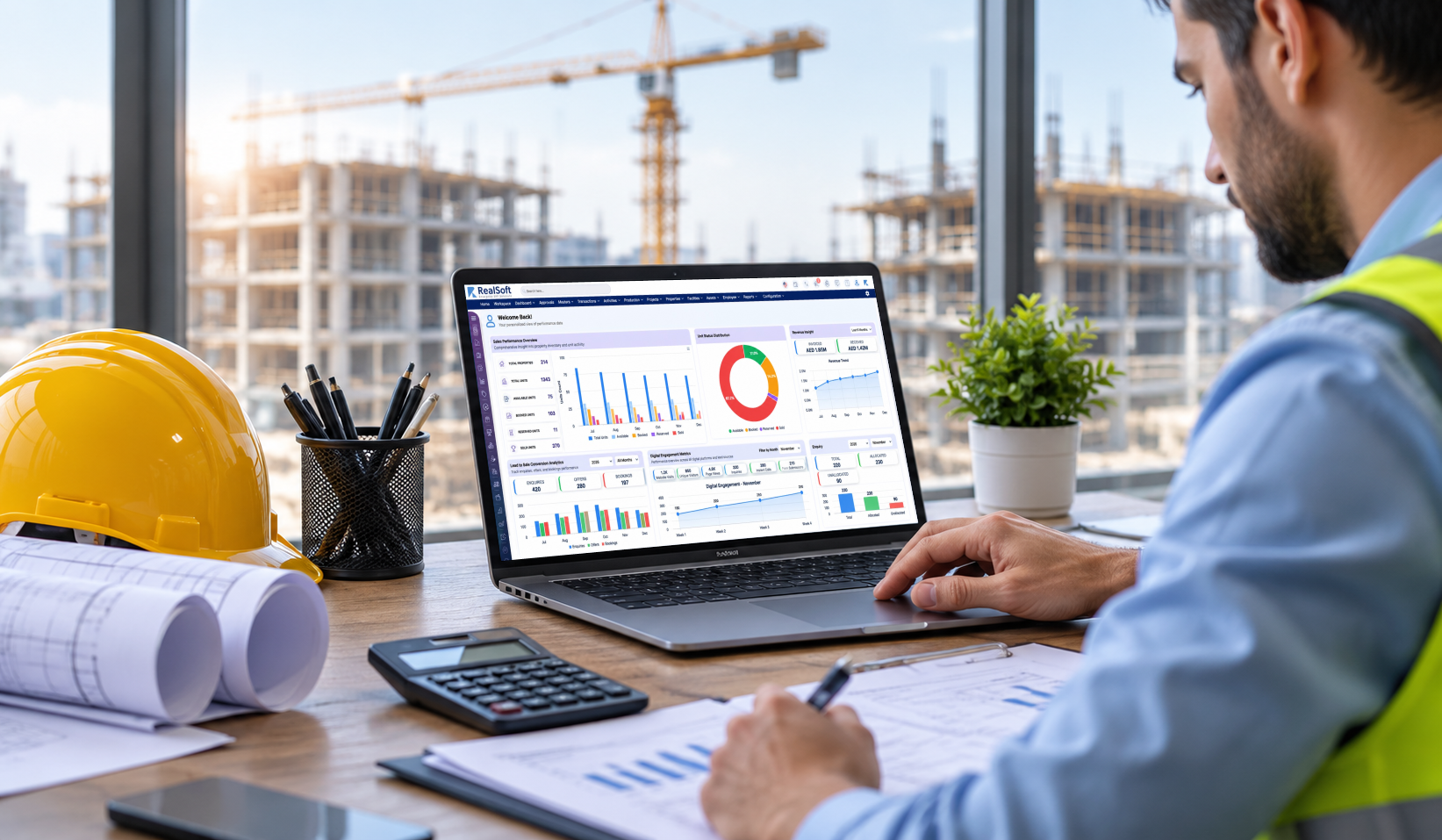
Construction accounting software is a financial system that organises accounts around individual projects, contracts and cost codes, not just the company ledger. For UAE contractors it should cover job costing, budget-versus-actual, progress billing, retention, WIP, cash-flow visibility, VAT and e-invoicing readiness, so management knows which projects make money and which are draining cash.
A construction company can report strong revenue and still be short of cash. Customer payments arrive late, supplier invoices fall due, subcontractor costs rise and project spending drifts past the estimate. In Dubai, Abu Dhabi, Sharjah and across the UAE, the fix is to connect finance with project budgets, purchasing, billing and inventory. This guide covers what to look for, three free project calculators you can run on your own numbers, and a practical way to test any vendor. For the wider project picture, see our Realsoft construction ERP.
What Is Construction Accounting Software?
It is a financial management solution for contractors, subcontractors, engineering companies and other project-based businesses. Unlike basic bookkeeping, it organises financial information around individual projects, contracts, activities or cost codes, connecting company accounting with the commercial reality of construction work. Depending on the platform and configuration, it may support:
Project-wise income & expense
Job costing & cost codes
Accounts payable & receivable
Supplier & subcontractor payments
Progress billing
Budget vs actual
Cash-flow forecasting
Work-in-progress reporting
Retention receivable & payable
VAT & tax reporting
Multi-project reporting
Procurement, inventory, payroll links
The right combination depends on the size of the contractor, the complexity of its contracts and the accounting methods the business requires.
Why General Accounting Software May Not Be Enough for Construction Companies
A conventional accounting system can record transactions accurately without providing the project-level visibility a contractor needs. A company running five projects may see total revenue, expenses, receivables and payables — but management also needs to know which projects are profitable, which are over budget and which require additional cash.
| PROJECT | REVENUE | COST | MARGIN |
|---|---|---|---|
| Project A | AED 4.00m | AED 3.44m |
|
| Project B | AED 2.50m | AED 2.65m |
|
| Project C | AED 3.00m | AED 2.73m |
|
| Company total | AED 9.50m | AED 8.82m |
|
Illustrative figures. A 7.2% company margin hides a project losing 6%.
Five specific gaps explain why project-based finance needs more than a general ledger:
01
Project expenses need to be allocated correctly
Costs include materials, labour, equipment, subcontractors, transportation and site overheads. If transactions are recorded only under general expense categories, the true performance of each contract is hard to see.
02
Project revenue and cash collection are different
An approved invoice does not mean the money has reached the bank. Contractors need to distinguish work completed, amounts billed, amounts certified, outstanding receivables and cash actually collected.
03
Supplier and subcontractor liabilities accumulate
Materials may be purchased long before a customer payment is received, and subcontractors invoice by milestone or progress. Without clear due dates and expected receipts, payment planning suffers.
04
Project changes affect the forecast
Variations, revised quantities, delays and additional work change both expected cost and the amount recoverable. If approved changes are not reflected, the budget stops representing the real commercial position.
05
Company-wide profit can hide project-level problems
A profitable contract may temporarily offset losses on another. Project-level reporting shows where margins are weakening and where commercial or operational action is required.
06
The fix
Project-level reporting that shows where margins weaken and where commercial or operational action is needed.
Check Your Project Variance, Cash Gap and Billing Position
Profitability and liquidity are different things. These three checks use your own project numbers to show where cost is drifting, how much cash is really available, and whether you are billing ahead of or behind the work. Everything runs in your browser; nothing is sent or stored.
1. Budget vs Actual Variance
One project, AED. Prefilled with an illustrative example.
2. Project Cash Gap & Retention
Where cash stands today and over the next 30 days, in AED.
The project is AED 550,000 short over the next 30 days even though AED 300,000 of retention is still owed to you. Plan funding or payment timing now.
See Receivables & Cash Visibility3. Overbilling / Underbilling (Illustration)
Simple cost-to-cost view of one contract, AED.
You have billed AED 500,000 more than the work earned so far. That helps cash now but is typically carried as a liability, and you still owe the remaining work.
Ask About WIP Reporting7 Features to Look for in Best Manufacturing ERP Software
Use these seven as your evaluation frame. For each one, ask the vendor to show it working on your own product, not describe it on a slide.
Job Costing and Project-Wise Accounting
Job costing links eligible expenses and revenue to individual jobs so performance can be reviewed against estimates and budgets. A civil project, for example, may carry separate categories for concrete, reinforcement steel, labour, equipment hire, subcontractors and site overheads.
- Project and cost-code structures
- Project profitability reports
- Direct and indirect allocation
- Historical cost analysis
- Budget-versus-actual
- Multi-project reporting
Project Budgeting and Financial Variance Analysis
The original budget is the financial reference for monitoring execution. As purchase orders are approved, labour costs recorded and supplier invoices arrive, the contractor needs to see how the position is changing — with committed costs included where the system provides that functionality. Edit the illustrative figures below to see how offsetting categories can hide an overrun:
Accounts Payable and Supplier Payment Management
Construction businesses frequently purchase from multiple suppliers. Accounts payable management maintains supplier invoices, outstanding balances, payment terms and due dates. A connected system can help trace supplier invoices to the relevant purchasing documents and project references, depending on the configured workflow. The goal is control over obligations without losing sight of the cash required for upcoming project activities.
- Supplier statements
- Outstanding liability reports
- Due-date tracking
- Advances and adjustments
- Payment approvals
- PO and receipt matching where supported
Ask: “Trace this supplier invoice back to its PO, receipt and project.”
Accounts Receivable and Progress Billing
Construction revenue follows contract terms, measured progress, milestones or certified work, not a one-off retail sale. After a progress claim, the business must track the claim, invoice status, deductions, amounts received and the remaining balance.
- Milestone or progress billing
- Receipt allocation
- Receivables ageing
- Variations and billing revisions
- Credit notes and adjustments
- Invoice registers
Ask: “Raise a progress claim with a deduction, then record part-payment.”
Retention Receivables and Payables
Retention is a portion of a payment withheld until contract conditions are met. A main contractor may have retention withheld by its customer while withholding retention from subcontractors. Track these separately from ordinary invoices, because release dates and conditions differ.
Ask: “Raise a progress claim with a deduction, then record part-payment.”
Work-in-Progress and Revenue Recognition
WIP reporting relates project execution, costs incurred, billing and recognised revenue. It is not simply the total of costs not yet invoiced; the treatment depends on the contract, the accounting framework and the company’s revenue-recognition policy.
- Project cost accumulation
- Billed vs earned revenue
- Contract value and approved variations
- Over- and underbilling indicators
- Progress or completion data
- Period-end adjustments
Cash Flow Forecasting and Working Capital Visibility
A project can be profitable and still short of cash if supplier payments fall due before customer receipts arrive. Forecasting needs both expected inflows and planned outflows, refreshed often.
- Expected customer collections
- Equipment rental, mobilisation
- Supplier and subcontractor dates
- Retention release timing
- Payroll and operating expenses
- Certification and collection delays
Ask: “Show a 30-day cash view for one project from receivables and payables.”
UAE VAT, Corporate Tax and E-Invoicing Readiness
For VAT-registered businesses the system should apply the right VAT treatment and support accurate reporting. The standard VAT rate is 5% for taxable supplies unless a different treatment applies. Corporate Tax accounting should be assessed against your legal structure. E-invoicing is phased in, and an ordinary PDF or scanned invoice is not, by itself, an e-invoice under the system. See the dates below.
Multi-Project, Multi-Company and Multi-Currency Accounting
Some contractors run projects across several Emirates, keep multiple legal entities or buy from overseas suppliers. Confirm how the solution handles:
- Separate company ledgers
- Project and department reporting
- Foreign currency and exchange adjustments
- Intercompany transactions
- Consolidated management information
- Access controls and approvals
How Construction Accounting Software Connects Finance with Site Operations
Accounting accuracy depends on what the rest of the business feeds it. A supplier invoice starts as a site request, a supplier selection, an approved PO and a goods receipt. If those records are disconnected, finance re-enters data or chases several departments. An integrated construction ERP can connect the stages:
Area | What it can support | What it depends on |
|---|---|---|
Procurement | Purchasing records supporting supplier invoices and project costs | Approved PO and receipt workflow |
Inventory | Material receipts and stock movements for accounting treatment of materials | The configured inventory method |
Project management | Progress and approved variations informing commercial reviews and billing | Variation approval discipline |
Payroll & timesheets | Labour cost allocated to projects | Necessary records and integrations |
Billing | Customer invoices and receipts linked to receivables and project reports | Contract billing terms set up correctly |
Management reporting | Project and company performance from one consistent set of records | Modules implemented and users following procedure |
Construction Accounting Software for Different Types of UAE Contractors
Civil and general contractors
Materials, labour, equipment, subcontractors, budgets and billing across work packages. Job costing and project-level reporting matter most on long contracts.
MEP contractors
Specialist equipment, materials, subcontractors, installation labour and staged billing. Look for detailed cost allocation and visibility of purchasing commitments.
Interior fit-out companies
Several projects with different specifications, suppliers, schedules and variation requests. Track cost and billing changes as scope evolves.
Subcontractors and specialists
Labour costs, material purchases, receivables, supplier obligations and retention, without unnecessary complexity.
Multi-site construction companies
Consolidated reporting with project detail, and clarity on which company, project, department or cost centre owns each transaction.
RealSoft ERP for Construction Accounting and Project Financial Management
RealSoft ERP by Coral Business Solutions provides ERP capabilities relevant to construction and project-based businesses. For companies evaluating construction accounting software in the UAE, the important question is how the selected configuration connects finance with the rest of the project lifecycle. Areas to assess:
Project costing & budgeting
Accounting & reporting
Procurement & inventory
Project management
Billing & receivables
Implementation & reporting
The availability of individual features depends on the modules selected and the implementation scope. Request a demonstration using a representative project — including a supplier invoice, project expense, customer billing transaction and financial report.
Explore: Construction Management Software · Project Management ERP · Construction and Civil Contracting ERP
How to Choose the Best Construction Accounting Software in Dubai
Before purchasing a system, compare it against your business’s financial and operational needs:
01
Define the reporting requirements
Identify which project, company, cost-code and management reports your finance team needs.
02
Test job costing
Use a real or representative project to check how material, labour, equipment and subcontractor costs are allocated.
03
Verify billing workflows
Confirm support for the progress claims, milestones, variations and retention arrangements in your contracts.
04
Review cash flow visibility
Check whether receivables, payables and payment forecasts are presented in a useful format.
05
Check tax requirements
Verify VAT treatment, Corporate Tax reporting and e-invoicing integration with the vendor and your tax adviser.
06
Evaluate integrations
Determine whether accounting must connect with procurement, inventory, payroll and project management.
07
Confirm financial controls
Review permissions, approval workflows, audit trails, period-end procedures and data access.
08
Calculate total cost of ownership
Include licensing, implementation, data migration, customisation, integrations, training and support.
09
Check scalability
Consider additional projects, users, locations and legal entities as the business grows.
10
Request a practical demonstration
Ask the vendor to show the full flow, from a project purchase or labour cost to the financial report.
The best construction accounting software is the solution that gives your business reliable financial information and fits the way your contracts operate.
Frequently Asked Questions
What is the best construction accounting software in the UAE?
The best solution depends on your project complexity, job-costing requirements, billing methods, financial controls and integration needs. Contractors should compare construction ERP platforms and general accounting products against their own workflows rather than relying only on feature lists or rankings.
What is the difference between construction accounting software and construction ERP?
Construction accounting software focuses on financial transactions, ledgers, reporting and related accounting workflows. Construction ERP can connect accounting with project management, procurement, inventory, payroll and other business processes. The appropriate option depends on how much integration the contractor needs.
Can construction accounting software track profit by project?
Yes, when the system supports project-level cost and revenue allocation and the business records transactions consistently. Project reports can compare relevant revenue and expenses to show financial performance, subject to the company’s accounting policies.
Does construction accounting software support progress billing?
Some construction accounting and ERP systems support progress-based or milestone-based billing. Contractors should confirm that the solution matches their contract terms, certification process and invoice requirements.
What is job costing in construction accounting?
Job costing is the process of assigning eligible project expenses and revenue to individual jobs, cost codes or activities. It helps contractors understand how actual financial performance compares with the original estimate or budget.
What is WIP accounting in construction?
Work-in-progress accounting concerns the financial treatment and reporting of work on contracts that are still in progress. Its calculation and revenue-recognition implications depend on the applicable accounting framework and contract circumstances, so the required methodology should be confirmed with a qualified accounting professional.
Can construction accounting software manage retention?
Some construction accounting systems support retention tracking for customer receivables and subcontractor or supplier payables. Verify how the software handles withheld amounts, release conditions, due dates and settlement records.
What should UAE contractors check about electronic invoicing?
Contractors should verify whether they fall within the applicable UAE e-invoicing implementation phase, understand the relevant deadlines and confirm that the proposed software can support the required technical arrangements. The official Federal Tax Authority guidance should be consulted for current information.
Make Financial Information Useful for Project Decisions and Cash Flow Planning
Contractors need to understand project costs, supplier obligations, customer collections, billing progress and financial performance without relying on disconnected records. See how RealSoft ERP connects accounting with project and operational workflows — using a project of your own.