
Most ERP buyers approach the investment decision backwards — they compare sticker prices between vendors instead of calculating what the software will actually return. Here is the real formula, the inputs that matter, and the 2026 industry benchmarks to validate your own numbers against.
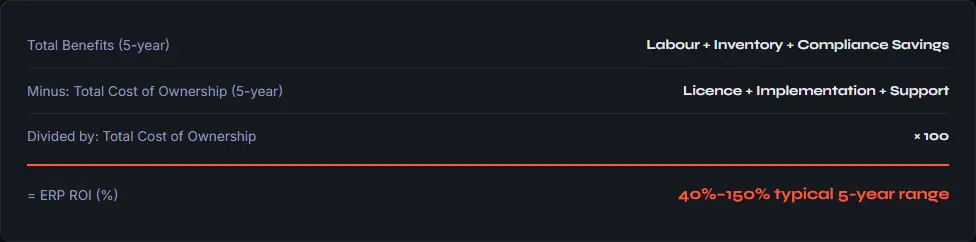
The ERP ROI Formula
2026 Industry ROI Benchmarks
40–150%
16–24 mo
100%+
4x
The 4 Real Drivers of ERP ROI
1. Reduced IT & Infrastructure Spending
The most immediate, measurable saving
Consolidating finance, inventory, HR, and CRM into one ERP eliminates the licensing costs, server hardware, and IT maintenance overhead of running multiple disconnected systems. For cloud ERP specifically, this also removes ongoing server upgrade and patching costs entirely — the vendor absorbs that cost.
2. Identifying Profitable vs Unprofitable Activity
Often the largest — and least visible — ROI driver
Real-time analytics surface which products, branches, or cost centres are actually profitable. Businesses routinely discover they’re subsidizing unprofitable product lines once an ERP gives them accurate cost-centre visibility — and reallocating that spend is often the single largest ROI contributor.
3. Faster Decision-Making
Speed has a direct dollar value
Real-time dashboards replace the multi-day lag of compiling reports manually from disconnected systems. This compounds — decisions made faster on inventory reorders, pricing, and cash flow reduce both stockout losses and excess holding costs.
4. Avoided Compliance Penalties
Especially significant for UAE businesses in 2026
With UAE Corporate Tax non-compliance penalties of up to AED 50,000, and e-invoicing violations carrying ongoing monthly fines from January 2027, an ERP that maintains continuous compliance turns penalty avoidance into a quantifiable, recurring ROI line item — not just a soft benefit.
The 4 Real Drivers of ERP ROI
Step 1 — Estimate Total Cost of Ownership (5 years): Add licensing or subscription fees, implementation cost, data migration, training, and ongoing support. For cloud ERP in the UAE, this typically ranges AED 100,000–400,000 over 5 years for an SME; on-premise ranges higher due to infrastructure costs.
Step 2 — Estimate Total Benefits (5 years): Quantify labour hours saved from automation (multiply by loaded hourly cost), reduced inventory carrying costs from better stock visibility, and avoided compliance penalties based on your current risk exposure.
Step 3 — Apply the Formula: ((Total Benefits − Total Cost) ÷ Total Cost) × 100 = your ROI percentage. Compare this against the 40–150% 5-year industry benchmark to sanity-check your numbers before presenting a business case.
Why Most ERP ROI Estimates Are Wrong — And How to Fix Them
The most common mistake in ERP ROI calculations isn’t an error in the formula — it’s an incomplete list of inputs. Businesses routinely include the obvious savings (reduced headcount, lower software licensing) and skip the larger, less visible ones. Compliance penalty avoidance is the clearest example: a UAE business that has never been audited tends to assign it zero value, treating it as a hypothetical risk rather than a quantifiable one. But with Corporate Tax record-keeping penalties reaching AED 50,000 per violation and e-invoicing non-compliance carrying ongoing monthly fines from 2027, the realistic expected value of penalty avoidance — even at a modest probability — is rarely zero. The second most common gap is opportunity cost: the revenue lost when a business can’t fulfil an order because of inaccurate stock visibility, or loses a deal because a quote took three days to prepare instead of three minutes. These are harder to quantify precisely, but excluding them entirely understates ROI by a wide margin. A defensible ERP business case includes a conservative estimate for both, clearly labelled as such, rather than omitting them because they’re inconvenient to calculate.
Cloud vs On-Premise: The ROI Gap That Surprises Most Buyers
One of the most consistent findings across 2026 industry research is that cloud ERP delivers meaningfully faster ROI than on-premise deployment — not marginally faster, but up to four times the return according to recent analysis. The driver isn’t just lower upfront licensing cost. It’s the combination of faster implementation (3–6 months for cloud versus 12–18 months for on-premise), the complete elimination of server hardware and IT maintenance costs, and — specifically relevant for UAE businesses — automatic regulatory updates as VAT, Corporate Tax, and e-invoicing rules change. An on-premise system requires your IT team to manually apply each compliance update, which is itself a recurring, often underestimated cost that erodes ROI over the system’s lifetime. When building your own ROI case, model both deployment options separately rather than assuming the headline licence price tells the full story.
Frequently Asked Questions
What is a good ROI for ERP software?
A 5-year ROI of 40–150% with a payback period of 16–24 months is considered a strong, defensible benchmark for 2026. SMBs replacing heavily manual processes often achieve over 100% ROI within 2 years because their pre-ERP baseline inefficiency is high relative to software cost.
How long does it take to see ROI from ERP implementation?
Most businesses reach payback within 16 to 24 months. Cloud ERP typically delivers faster payback than on-premise systems due to lower upfront costs and faster implementation timelines (3–6 months vs 12–18 months for on-premise).
What is the ERP ROI formula?
ROI (%) = ((Total Benefits − Total Cost of Ownership) ÷ Total Cost of Ownership) × 100. Total benefits include labour savings, reduced inventory costs, and avoided compliance penalties; total cost of ownership includes licensing, implementation, and 5-year support.
Want a More Accurate ERP ROI Estimate?
Every business has a different cost structure, compliance exposure, and operational complexity. A tailored ROI assessment can help identify the specific savings opportunities and payback period relevant to your organisation before you invest.