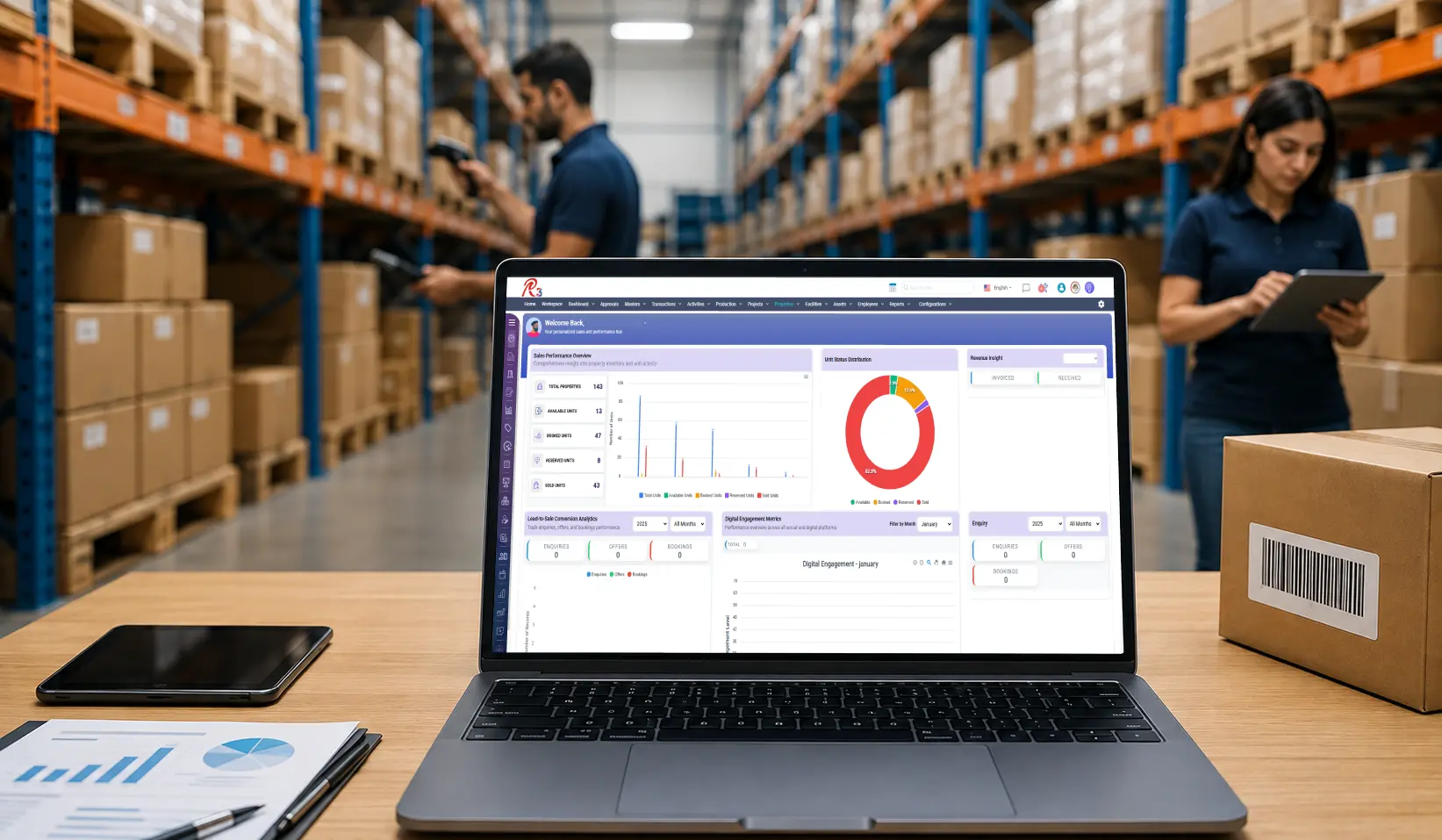
A guide for UAE manufacturers and industrial businesses — written for the person who has to live with the decision, not the person writing the listicle.
If you’re reading this, you’ve probably already looked at a handful of “best inventory management software” lists and found they don’t say much. Ten logos, a paragraph each, no real answer to the question you actually have: will this work for how my business actually operates?
This guide skips the listicle format. It’s written for the person who has to live with the decision — the owner, ops manager, or finance lead who’ll be the one explaining to their team in six months why the new system does or doesn’t work.
Before you compare features
The real cost of getting this wrong
It’s worth being honest about what a bad inventory system actually costs a business — none of it shows up as a tidy line item.
- Stock discrepancies that surface at year-end, not in real time — by which point the margin damage is already done.
- Manual reconciliation between the warehouse and finance, because the inventory system doesn't talk to accounting.
- Reorder decisions made on gut feel, because the system can't tell you which of 2,000 SKUs actually needs attention this week.
- Rework and wastage that never gets costed properly, because the system tracks quantity but not batch-level cost.
These show up as margin that quietly erodes and nobody can point to why. If any of that sounds familiar, the issue usually isn’t effort — it’s that the software wasn’t built for how your business actually moves stock.
In order of what matters most
Why most "inventory software" doesn't fit manufacturing
Most inventory tools on the market — including several that show up at the top of comparison sites — are built for retail and e-commerce. Scan an item in, scan it out, done. That model assumes you’re selling what you bought. It falls apart the moment you’re making what you sell.
If your business fabricates, assembles, processes, or converts raw material into finished product, your inventory isn’t one number — it’s three, moving simultaneously:
Raw material
What you've bought and received — steel, resin, packaging stock, components. Sitting cost, not yet transformed.
Work-in-progress
What's mid-production — partially consumed against a job or BOQ, not yet sellable, easy to lose visibility on.
Finished goods
What's complete and ready to invoice — the only one of the three a retail-style tool was ever built to track.
- a retail-style tool shows stock counts, but not where cost is actually sitting, or whether a batch with a quality issue has already reached finished product.
This is the actual distinction to make when comparing options — not “inventory software” vs. “better inventory software,” but stock-counting tools vs. ERP systems built for production.
IN ORDER OF WHAT MATTERS MOST
What to actually evaluate Inventory Management Software in UAE
01
Can it trace a batch from raw material to finished product?
If a supplier sends a bad batch of steel, resin, or packaging material, can you find every finished unit it touched — in minutes, not days? This is heat number / batch tracking, and it’s the single most consequential feature for any business with quality or compliance exposure.
02
Does it cost by batch, or average everything out?
Raw material prices move. Wastage varies. If your system calculates one blended cost across all inventory, you’re losing visibility into which jobs, batches, or products are actually profitable. Real batch costing shows the truth per unit, not a comfortable average.
03
Does inventory move with production automatically?
If your team manually adjusts stock after the fact, the numbers are always slightly wrong and always a step behind. A system that reduces raw material stock automatically against a Bill of Quantities as production happens is the difference between tracking and control.
04
Can it handle your actual SKU volume?
A system that works with 50 items often buckles at 2,000. Ask specifically how reorder points, search, and classification work at your real scale — not the vendor’s demo scale.
05
Is it one system, or three pretending to be one?
Inventory, purchasing, and finance need to be the same system, not three tools stitched together with exports and manual entry. Every integration point is a place where numbers quietly stop matching.
06
Is it ready for FTA e-invoicing — natively?
With the UAE’s e-invoicing rollout underway — pilot phase from July 2026, ASP accreditation required by October 2026, mandatory nationwide by 2027 — any system you invest in now needs to generate compliant invoices from the same data it uses to track stock. A separate invoicing tool means reconciling two sources of truth indefinitely.
A straightforward way to decide
Stock app, or ERP?
A lighter tool is genuinely enough if…
you’re not manufacturing or fabricating — you’re purely trading finished goods. Don’t overbuy.
You're in ERP territory if any of these are true
- You convert raw material into a different finished product
- You need to trace a batch or serial number back to its source
- You cost jobs or products individually, not as a blended average
- You manage inventory against a Bill of Quantities or production order
- Stock spans a factory plus one or more separate warehouses
Where RealSoft ERP fits
Built and refined specifically for this kind of business — fabrication, steel distribution, packaging, food manufacturing, and industrial supply among them. In practice, that means:
- Item-level batch and heat number tracking as a core feature, not a workaround
- Real batch costing, so margin visibility reflects what actually happened
- Automatic stock consumption against BOQs and production orders
- One system spanning inventory, purchasing, and finance — no reconciliation gaps
- Native FTA e-invoicing, ready ahead of the mandatory rollout
Want a straight answer, not a sales pitch?
The fastest way to know if a system fits is to look at it against your actual item list and production process — not a demo dataset.