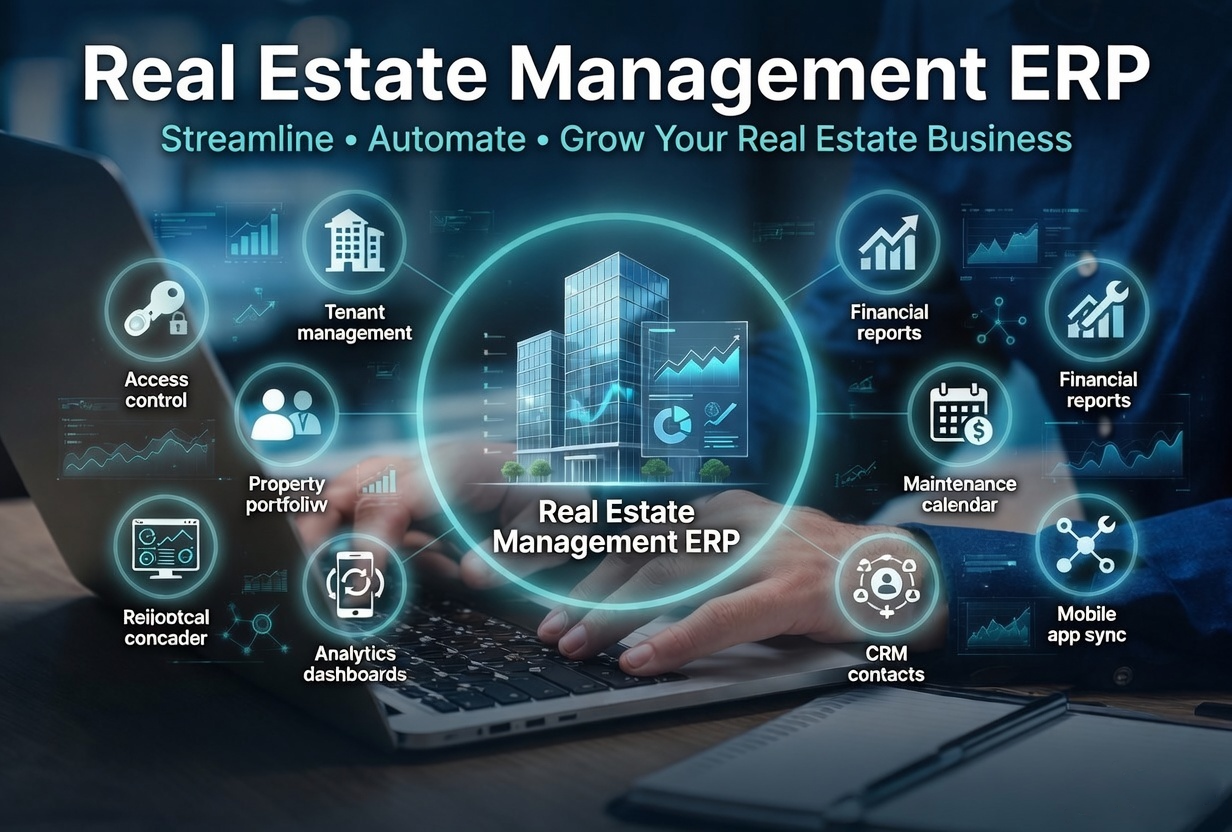
The UAE Real Estate Market in 2026
The UAE real estate market continues to be one of the most dynamic and tightly regulated property environments in the world. With record transaction volumes in Dubai and Abu Dhabi, sustained demand from international investors, and sweeping digital transformation mandates from regulatory authorities, property businesses in the UAE operate at a pace and complexity that manual processes simply cannot support.
Developers are managing multi-phase projects spanning hundreds of units. Brokerages are handling hundreds of inbound leads each month. Property managers are juggling thousands of lease renewals, PDC cheques, and maintenance requests simultaneously. And finance teams are navigating UAE VAT, the new corporate tax regime, and evolving Federal Tax Authority (FTA) e-Invoicing requirements.
In this environment, real estate management software UAE has moved from a nice-to-have to a non-negotiable operational infrastructure. The right platform centralises every function — sales, leasing, finance, compliance, and customer service — into a single intelligent system.
UAE PROPERTY TRANSACTIONS IN 2025
UAE VAT ON COMMERCIAL PROPERTY
CORPORATE TAX RATE FROM 2023
YEARS OF UAE ERP EXPERTISE — REALSOFT
What Is Real Estate Management Software?
Real estate management software is a purpose-built digital platform that automates, integrates, and centralises the end-to-end operations of a property business. Unlike generic accounting or CRM tools, a true real estate platform is designed around the specific workflows, document types, regulatory requirements, and revenue models that define the property industry.
A complete real estate and property management software system typically covers:
- Unit inventory and project management for developers
- Sales Purchase Agreement (SPA) lifecycle management
- Installment tracking and milestone-based billing
- Lease contract creation, renewal, and expiry management
- Tenant and buyer relationship management
- Post-dated cheque (PDC) monitoring and reconciliation
- VAT-compliant invoicing and financial reporting
- Facility and maintenance management
- HR, payroll, and staff performance tracking
When all of these functions operate within a single integrated platform — rather than across spreadsheets, email threads, and disconnected tools — property businesses gain real-time visibility, reduce revenue leakage, and position themselves to scale.
Why UAE Businesses Need Specialised Real Estate Software
Generic ERP or CRM systems are built for broad industries. They lack the depth to handle the specifics of real estate property management in the UAE context. Here is why specialisation matters:
01
SPA documentation and installment sales
The Sales Purchase Agreement is the legal and financial backbone of UAE property developer sales. Tracking milestone payments, amendment histories, and escrow-linked revenue recognition requires software designed specifically around this document type. A generic accounting system cannot do this without costly, complex customisation.
02
RERA compliance and escrow management
Developers operating under RERA must maintain escrow accounts for each project and release funds only against verified construction milestones. Real estate management software in UAE that supports escrow-linked revenue recognition protects developers from compliance risk and audit exposure.
03
Multi-currency and multi-project complexity
Large UAE developers manage multiple projects simultaneously — often in different emirates, involving international buyers transacting in multiple currencies. Real estate software must handle this complexity natively.
04
Rental escalation and PDC management
For property managers, rental escalation schedules and post-dated cheque tracking are core operational tasks. Automating these within a real estate property management platform eliminates manual errors and prevents revenue loss.
Core Features to Look for in Real Estate Management Software
When evaluating any real estate and property management software platform, assess against these critical capabilities:
SPA lifecycle management
Digital SPA creation, amendment tracking, milestone billing, and buyer history — all in one place.
Unit inventory control
Real-time availability, dynamic pricing, blocked vs. sold status, and multi-project dashboards.
Customer & tenant CRM
Lead capture, automated follow-ups, pipeline visibility, and agent performance analytics.
Lease & renewal automation
Contract generation, automated renewal alerts, escalation schedules, and vacancy analysis.
VAT & financial reporting
Automated VAT calculation, tax-ready invoicing, project-wise P&L, and cash flow forecasting.
Facility management
Work order automation, preventive maintenance scheduling, vendor coordination, and cost tracking.
Mobile apps
Buyer, tenant, and landlord mobile apps for payments, documents, and service requests.
AI-powered dashboards
Role-based intelligent workspaces with predictive analytics, alerts, and occupancy forecasting.
Real Estate Customer Management Software Explained
One of the most underestimated components of a complete platform is real estate customer management software. In the UAE market, where buyers frequently interact with multiple developers and brokers simultaneously, the speed and quality of follow-up is often the deciding factor in a sale.
A purpose-built real estate CRM goes far beyond a contact list. It provides:
- Omnichannel lead capture — from websites, property portals (Bayut, Property Finder, Dubizzle), WhatsApp, and walk-ins, all feeding into a unified pipeline.
- Automated nurture sequences — timed SMS and email follow-ups triggered by lead behaviour, not manual reminders.
- Broker and agent performance dashboards — conversion rates, response times, and revenue attribution per agent or team.
- Source-based ROI tracking — understanding which marketing channels generate the most qualified leads and revenue.
- Post-sale customer journey management — connecting the CRM to SPA management and payment tracking so that every buyer relationship continues seamlessly after signing.
When real estate customer management software is integrated with the broader ERP — rather than running as a standalone CRM tool — organisations eliminate the fragmentation that causes leads to fall through the cracks and commissions to go untracked.
Real Estate and Property Management Software: Beyond Sales
While developer sales automation attracts significant attention, the operational depth of real estate property management is equally important for long-term profitability.
Property management companies and developers with rental portfolios must handle:
Tenancy contract lifecycle
From EJARI registration through to renewal or termination, tenancy contracts must be tracked with precision. Missed renewal windows cost vacancy periods and revenue. Automated renewal alerts, built into the platform, ensure no contract lapses unnoticed.
PDC cheque monitoring
Post-dated cheques are still widely used in UAE rental transactions. Managing dozens or hundreds of PDC cheques manually — tracking presentation dates, bounced cheques, and replacements — is operationally risky. A dedicated PDC management module automates this entirely.
Security deposit and utility tracking
Security deposit management, utility reconciliation, and clearance processing are routine property management tasks that must be handled accurately to avoid legal disputes with tenants.
Landlord transparency
For property management companies acting on behalf of individual landlords, a landlord mobile app providing real-time visibility into rental income, expenses, and occupancy status is a competitive differentiator.
How to Choose the Right Real Estate Management Software UAE
When evaluating platforms, UAE property businesses should use this checklist to separate genuine real estate software from retrofitted generic tools:
- Purpose-built for UAE real estate — not a generic ERP with property modules bolted on
- Full SPA lifecycle management with installment and milestone tracking
- UAE VAT, Corporate Tax, and FTA e-Invoicing compliance built in
- Integrated real estate customer management software (CRM)
- Lease and tenancy management with PDC tracking and renewal automation
- Escrow management support for RERA compliance
- Multi-project and multi-branch capability
- Customer, tenant, and landlord mobile applications
- AI-powered dashboards with role-based workspaces
- Local UAE implementation team and ongoing support
Selecting a platform without these capabilities often leads to costly customisation, ongoing compliance risk, and poor adoption across teams who are forced to maintain manual workarounds.
Why RealSoft by Coral Business Solution LLC
RealSoft is engineered specifically for UAE and GCC real estate companies. With 24+ years of ERP expertise and 5,000+ successful implementations, it brings together every function discussed in this guide — developer sales, lease management, real estate customer management, VAT-compliant finance, Corporate Tax, e-Invoicing, facility management, and AI dashboards — within a single, deeply integrated platform.
Unlike international generic platforms, RealSoft ships with UAE compliance pre-built, local regulatory updates included, and a dedicated UAE-based implementation and support team.
Frequently Asked Questions
What is real estate management software used for in the UAE?
Real estate management software in UAE automates the full property business lifecycle — from unit sales and SPA documentation through to lease management, VAT compliance, e-Invoicing, tenant communications, facility maintenance, and financial reporting. It replaces disconnected spreadsheets and tools with a single integrated platform.
Is real estate customer management software different from a regular CRM?
Yes. Real estate customer management software is purpose-built for property sales and leasing workflows — including lead capture from property portals, SPA status tracking, commission management, and post-sale buyer engagement. A generic CRM requires heavy customisation to replicate this and still lacks native integration with SPA, finance, and compliance modules.
Does real estate property management software handle VAT in the UAE?
A purpose-built platform like RealSoft handles UAE VAT automatically across all transaction types — correctly applying 5% to commercial transactions, zero-rating eligible residential first sales, generating tax-ready invoices, and producing FTA-compliant financial reports. This eliminates manual VAT calculation errors and reduces audit risk.
What is the difference between real estate management software and property management software?
Real estate management software covers the full spectrum — developer sales, SPA management, CRM, finance, and compliance. Property management software traditionally focuses on the leasing side — tenancy contracts, rent collection, maintenance, and landlord reporting. The best platforms, like RealSoft, combine both into a unified real estate and property management software system.
How long does it take to implement real estate management software UAE?
Implementation timelines vary based on organisation size and complexity. For a mid-sized property developer or management company, a structured RealSoft implementation typically takes 8–16 weeks — including data migration, team training, compliance configuration, and go-live support.
Is cloud-based real estate management software secure?
Enterprise-grade cloud real estate management software uses role-based access control, encrypted data storage, and audit trails to protect sensitive property, financial, and customer data. RealSoft’s cloud infrastructure is built to UAE data security standards with multi-branch access and mobile connectivity for executive teams.
Ready to Transform Your Real Estate Operations?
Join 5,000+ UAE and GCC property businesses already running on RealSoft ERP by Coral Business Solution LLC.