UAE E-INVOICING
The Complete FTA Compliance Guide
Electronic invoicing becomes mandatory across the UAE from January 2027. Every VAT-registered business conducting B2B and B2G transactions must comply — or face AED 5,000 monthly penalties.
AED 5K+
Monthly penalty for non-compliance
Jan 2027
Mandatory — large businesses
Oct 2027
Mandatory — all remaining
Mandatory deadlines are approaching
Understand the regulations, prepare your systems, and stay compliant with RealSoft ERP.
Compliance Deadlines
July 2026
31 July 2026
1 Jan 2027
1 Oct 2027
What Is UAE E-Invoicing?
Electronic invoicing — commonly called e-invoicing — is the digital exchange of invoice data between a seller and a buyer in a structured, machine-readable format. In the UAE context, this means moving entirely away from paper invoices and PDF documents toward XML-based structured data transmitted through government-approved channels.
If your business currently emails a PDF invoice to clients, that process will no longer be valid once the UAE e-invoicing mandate activates. The new system requires invoices to be generated, transmitted, and received in a standardized digital format — enabling the Federal Tax Authority (FTA) to validate transactions in real time.
Key Distinction
A PDF invoice is not an e-invoice. UAE e-invoicing requires a structured XML format that machines can read and validate automatically — not a scanned or digitally rendered document.
Authority
Format
XML — PINT-AE v1.0.1 or UBL standard. No PDFs, no paper, no scanned documents.
Scope
Network
The FTA Mandate: Ministerial Decisions 243 & 244 of 2025
The UAE’s e-invoicing journey accelerated significantly in September 2025 when the Ministry of Finance published two landmark regulations. Understanding both is essential for any VAT registered business operating in the UAE.
Ministerial Decision No. 243 of 2025
This decision defines the scope and core obligations of the Electronic Invoicing System (EIS). It establishes who must comply, what a valid e-invoice must contain, and the requirement to use approved technical channels for invoice exchange. In plain terms, it answers who and what.
Ministerial Decision No. 244 of 2025
This companion decision defines the mandatory rollout timeline, compliance deadlines by business size, and transitional arrangements. It answers when you need to be ready.
Who Must Comply?
All VAT-registered businesses in the UAE conducting B2B and B2G transactions are within scope. B2C transactions are currently excluded until a later phase is announced. Certain exemptions apply to government sovereign transactions, international passenger air transport, and select VAT-exempt financial services.
Official UAE E-Invoicing Timeline
The UAE has adopted a phased rollout to minimize disruption and allow businesses adequate preparation time. Here is the official schedule every finance and compliance team must know — and plan around.
Sep 2025
Ministerial Decisions 243 & 244 of 2025 published — establishing the legal framework, compliance scope, technical requirements, and rollout timeline for UAE e-invoicing.
1 Jul 2026
Voluntary pilot phase opens. Selected group of taxpayers can begin early testing and adoption through FTA-approved channels.
31 Jul 2026
Businesses with annual revenue ≥ AED 50M must appoint an Accredited Service Provider (ASP) by this date. Missing this deadline triggers the AED 5,000/month penalty immediately.
1 Jan 2027
Full e-invoicing compliance required for all businesses with AED 50M+ annual revenue. All B2B and B2G invoices must be transmitted as structured XML through an ASP.
1 Oct 2027
Full e-invoicing compliance required for all remaining VAT-registered businesses, including SMEs and smaller enterprises. No exemptions for businesses within scope.
Don't Wait for Deadlines
System upgrades, staff training, data migration, and ASP appointment all take time. Compliance experts recommend beginning your e-invoicing preparation at least 6 months before your mandatory date.
Technical Requirements: XML, Peppol & ASPs
The UAE e-invoicing system is built on internationally recognized standards, making it both robust and interoperable. Here is what your systems need to support:
01
Structured XML Format
All invoices must be created as structured XML files — specifically PINT-AE v1.0.1 (Peppol Invoice Standard for UAE) or UBL standard. PDFs, Word documents, and scanned invoices are explicitly invalid.
02
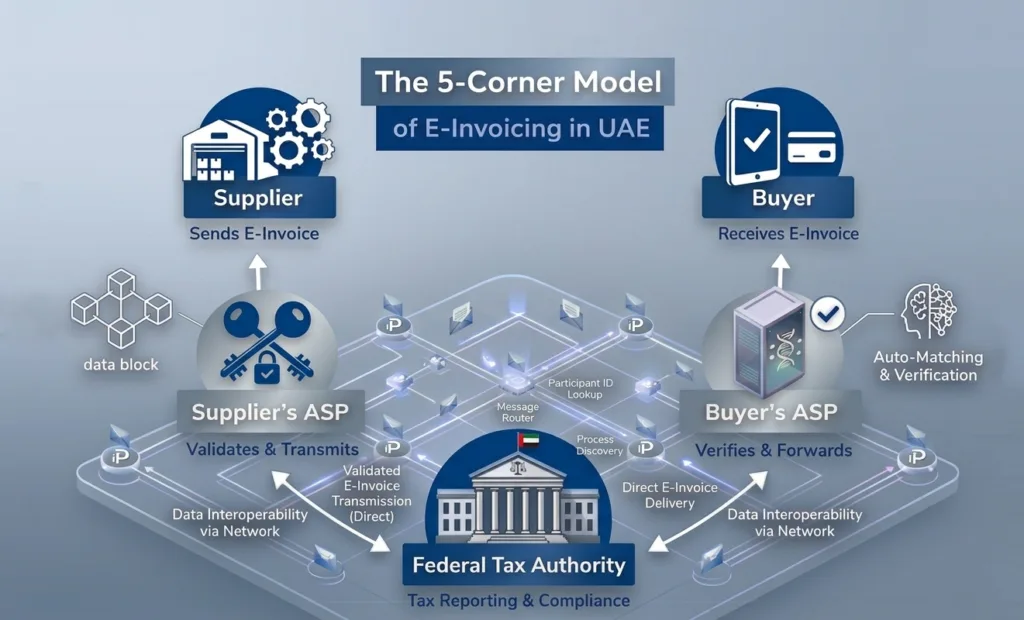
Peppol 5-Corner Infrastructure
Invoices flow: Seller → Seller’s ASP → Peppol network → Buyer’s ASP → Buyer, with the FTA receiving a validated copy. The same global infrastructure used in Europe, Singapore, and Australia.
03
Accredited Service Providers
Businesses cannot connect directly to Peppol or the FTA. You must route all invoices through an FTA-approved ASP who handles transmission, validation, and archiving.
Mandatory Invoice Fields
✓ Unique invoice number and issue date
✓ Detailed line items — unit prices, quantities, descriptions
✓ VAT amount, VAT rate, and taxable amount per line
✓ Total amount payable in AED
✓ Digital signature or integrity verification mechanism
✓ Peppol-compliant transaction identifiers
✓ Currency code and exchange rate (foreign currency invoices)
Archiving Requirements
All electronic invoices must be stored securely and in tamper-proof form for the period specified by FTA regulations. Invoices must remain verifiable at all times. Notably, they do not need to be stored locally within the UAE, but data integrity must be maintained.
Penalties for Non-Compliance
Cabinet Decision No. 106 of 2025 sets out a structured penalty framework. The UAE government has made clear that e-invoicing compliance is not optional.
AED
5,000/mo
Per month — failure to implement or appoint ASP
Beyond financial penalties, businesses that fail to comply face serious operational risks
including:
- Invoices rejected by buyers — directly disrupting revenue collection
- Inability to issue legally valid tax invoices under UAE law
- Increased exposure to FTA audits and investigations
- Cash flow disruption due to delayed or invalid invoicing
- Reputational damage with clients and trading partners
- AED 30,000+ in fines for a 6-month delay past the January 2027 deadline
How to Prepare Your Business for UAE E-Invoicing
Compliance is not a one-day switch. It requires a structured preparation program across finance, IT, and operations teams. Experts recommend beginning at least 6 months before your mandatory date.
01
Assess Your Current Invoice Processes
Map all invoice workflows — creation, approval, dispatch, and receipt. Identify every system involved: ERP, accounting software, billing tools. Understand your invoice volume and transaction type mix (B2B, B2G, B2C).
02
Confirm Your Compliance Timeline
Determine which phase applies based on your annual revenue. If you exceed AED 50 million, your ASP must be appointed by July 31, 2026 — and full compliance by January 1, 2027.
03
Appoint an Accredited Service Provider (ASP)
Research FTA-approved ASPs. Evaluate their integration capabilities with your ERP, pricing, support services, and Peppol certification. The appointment deadline for large businesses is July 31, 2026.
04
Upgrade or Integrate Your ERPUpgrade or Integrate Your ERP
Your ERP must generate XML invoices in PINT-AE format and connect to your chosen ASP. This is typically where businesses encounter the longest lead time — begin this step early. RealSoft ERP is already compliant.
05
Test, Train, and Go Live
Conduct end-to-end testing of invoice generation, transmission, and receipt workflows. Train your finance and accounts teams. Establish clear procedures for rejected invoices and error notifications. Run parallel testing before go-live.
Additional preparation steps include:
• Conduct gap analysis of current systems against e-invoicing requirements
• Engage your ERP vendor for e-invoicing readiness assessment
• Register on the Peppol network through your chosen ASP
• Complete data migration and master data cleanup
• Run parallel testing before the go-live date
• Update your invoice templates and internal approval workflows
• Ensure your archiving and audit trail systems are in place
How RealSoft ERP Makes UAE E-Invoicing Compliance Easy
RealSoft ERP is purpose-built for UAE compliance. Our platform covers every step of the e-invoicing process — from invoice generation to FTA submission — within a single, unified system. No disconnected add-ons. No manual steps. No compliance risk.
PINT-AE XML Format
Fully compliant structured XML invoice generation built directly into RealSoft ERP — no third-party converter required.
ASP Integration
Pre-built direct connectors to FTA-approved Accredited Service Providers — seamless Peppol network transmission from within your ERP.
Automated VAT Compliance
Automatic VAT calculation and TRN validation on every invoice — correct rates applied across all transaction types, every time.
Secure Archiving
Tamper-proof cloud storage with full audit trails and digital signatures — permanently audit-ready and FTA-verifiable.
Real-Time Status Tracking
Know instantly when each invoice is accepted, rejected, or queried by the FTA — with automated alerts and error handling workflows.
AI Compliance Dashboard
R3 AI Workspace monitors your e-invoicing compliance posture in real time — surfacing anomalies and audit risks before they escalate.
Why UAE Businesses Choose RealSoft ERP
✓ Purpose-built for UAE compliance — VAT, Corporate Tax, and e-Invoicing in one platform
✓ Seamless Peppol connectivity — we handle the 5-corner technical complexity for you
✓ Scalable for all business sizes — from SMEs facing 2027 to enterprises with Jan 2027 deadlines
✓ Dedicated UAE compliance support team — local experts who know FTA requirements
✓ Rapid implementation — structured onboarding gets you compliant before penalties apply
✓ 5,000+ UAE & GCC implementations — proven track record of compliance delivery
Frequently Asked Questions
When does e-invoicing become mandatory in the UAE?
The pilot phase begins July 1, 2026. Businesses with annual revenues above AED 50 million
must be fully compliant by January 1, 2027. They must also appoint an Accredited Service
Provider by July 31, 2026. Smaller businesses and SMEs face a mandatory deadline of
October 1, 2027.
Is a PDF invoice valid under UAE e-invoicing rules?
No. PDF invoices — even digitally generated ones — are explicitly invalid under the UAE e-invoicing mandate. All invoices must be in structured XML format (PINT-AE v1.0.1 or UBL) transmitted through an FTA-approved Accredited Service Provider.
What is an Accredited Service Provider (ASP)?
An ASP is an FTA-approved intermediary company that connects your business to the Peppol network. All e-invoices must be transmitted through your appointed ASP — businesses cannot connect directly to the network or the FTA. Your ASP handles validation, transmission, and archiving of invoice data.
Are B2C invoices included in the UAE e-invoicing mandate?
Not in the current phase. Business-to-consumer (B2C) transactions are excluded from the e-invoicing mandate until a later phase is announced by the FTA. The current mandate covers B2B and B2G transactions only.
What are the penalties for not complying with UAE e-invoicing?
Under Cabinet Decision No. 106 of 2025, the penalty is AED 5,000 per month for failing to implement the e-invoicing system or appoint an Accredited Service Provider. Additional consequences include rejected invoices, FTA audit exposure, and business disruption. A 6-month delay past the January 2027 deadline results in a minimum AED 30,000 in fines.
Does my ERP system need to be upgraded for UAE e-invoicing?
Most likely yes. Your ERP or accounting software needs to generate XML invoices in the PINT-AE format and integrate with an ASP. If you are using outdated software or a system not built for UAE compliance, you should begin evaluating your options immediately. RealSoft ERP is purpose-built for this — with PINT-AE XML generation and pre-built ASP connectors already integrated.
How long must I archive UAE e-invoices?
Invoices must be stored securely and remain tamper-proof and verifiable for the period defined by FTA regulations. Storage does not need to be physically within the UAE, but data integrity guarantees are mandatory. RealSoft ERP provides tamper-proof cloud archiving with full audit trails built in.
Don’t wait for the deadline
Get E-Invoice Compliant Today
RealSoft ERP gives UAE businesses a fast, reliable path to full FTA compliance — with expert local support every step of the way.
Contact us today and get a quote