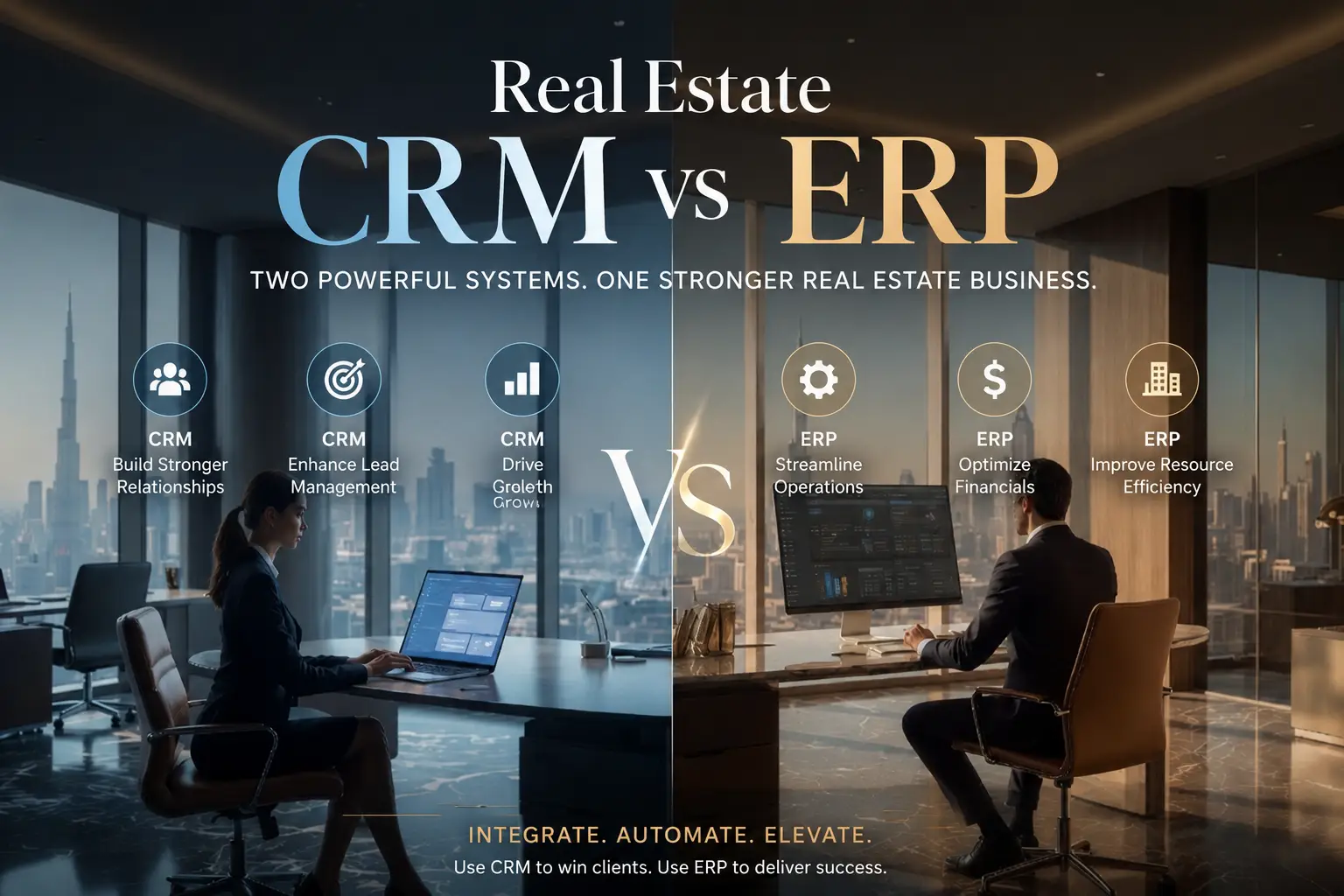
” A real estate company in Dubai starts with a simple requirement: “We need a CRM.”
Track leads. Manage inquiries. Follow up with prospects. Close more deals.
And for many brokers, that works — at least initially.”
But as the business grows, something unexpected happens. The CRM successfully manages leads, yet operational challenges continue to increase. Finance teams struggle with commission tracking. Property managers maintain separate databases. Service charge calculations become difficult. Project costs are tracked manually. Management lacks visibility into profitability.
Real Estate CRM vs ERP : Despite having a CRM, the organization still operates through disconnected systems. This is the point where many real estate businesses discover an important truth:
A CRM helps you manage customers. An ERP helps you manage the entire business.
Why CRM Became Popular in Real Estate
The real estate industry has always been relationship-driven. Success depends on how effectively businesses manage prospects, buyers, tenants, investors, and property owners. CRM systems were designed specifically to support these activities.
A typical CRM helps organizations:
Capture leads and manage inquiries
Track sales pipelines
Schedule follow-ups
Monitor broker performance
Automate communication
For brokerages focused primarily on sales, these capabilities provide significant value. However, a CRM was never designed to run an entire real estate organization — and that is where limitations begin to appear.
The Complete Property Lifecycle
The most useful way to evaluate any software is to follow the complete lifecycle of a property. This exercise reveals exactly where CRM stops and ERP begins.
Property Lifecycle — Who Handles What
1 | Lead Generation | CRM |
2 | Sales Process | CRM |
3 | Contract Management | Partial |
4 | Property Handover | ERP |
5 | Leasing & Tenancy | ERP |
6 | Maintenance | ERP |
7 | Service Charges | ERP |
8 | Long-Term Asset Management | ERP |
The conclusion is clear: CRM manages the beginning of the relationship. ERP manages the entire lifecycle.
Where ERP Begins
An ERP platform extends beyond customer management. It connects every department involved in delivering real estate services — creating a unified operational platform rather than a collection of disconnected systems.
Financial Management
General ledger, accounts receivable, accounts payable, budgeting, and reporting
Property Management
Service Charge Management
Automated service charge calculations and billing
Project Management
Procurement Management
Vendor management, purchasing, and approvals
Facility Management
Maintenance requests, work orders, and asset management
Why Developers Need More Than CRM
For property developers, the limitations of CRM become even more apparent. Developers must manage land acquisition, project budgets, construction costs, procurement activities, contractor payments, customer collections, handover processes, and asset management. A CRM simply was not designed to support these functions.
An ERP platform provides a centralized environment where every department works from the same source of information — eliminating data duplication and reporting inconsistencies.
Real Estate CRM vs ERP : Side by Side
Business Function | CRM | ERP |
|---|---|---|
Lead Management | ✓ | ✓ |
Sales Tracking | ✓ | ✓ |
Customer Communication | ✓ | ✓ |
Accounting | ✗ | ✓ |
Property Management | ✗ | ✓ |
Leasing Management | ✗ | ✓ |
Service Charges | ✗ | ✓ |
Procurement | ✗ | ✓ |
Project Costing | ✗ | ✓ |
Maintenance Management | ✗ | ✓ |
Financial Reporting | Limited | ✓ |
Operational Visibility | Limited | ✓ |
The comparison highlights a simple fact.
CRM is a sales tool.
ERP is a business management platform.
How RealSoft ERP Supports Dubai Real Estate Businesses
RealSoft ERP was developed to address the operational requirements of real estate companies in the UAE. The platform combines customer management capabilities with comprehensive business management functionality.
Final Verdict
Choosing between a CRM and ERP is not really about selecting one over the other — it is about understanding what your business actually needs.
If your objective is simply to manage leads and improve sales follow-ups, a CRM may be sufficient. However, if you need visibility into finance, leasing, operations, maintenance, projects, service charges, and profitability, a CRM alone will eventually become a limitation.
For growing brokers, developers, property managers, and real estate investment firms in Dubai, the future belongs to integrated platforms that connect every part of the business. That is where ERP delivers its greatest value.
Ready to Move Beyond CRM?
Discover how RealSoft ERP helps Dubai real estate companies manage sales, operations, finance, leasing, maintenance, and property management through a single integrated platform.