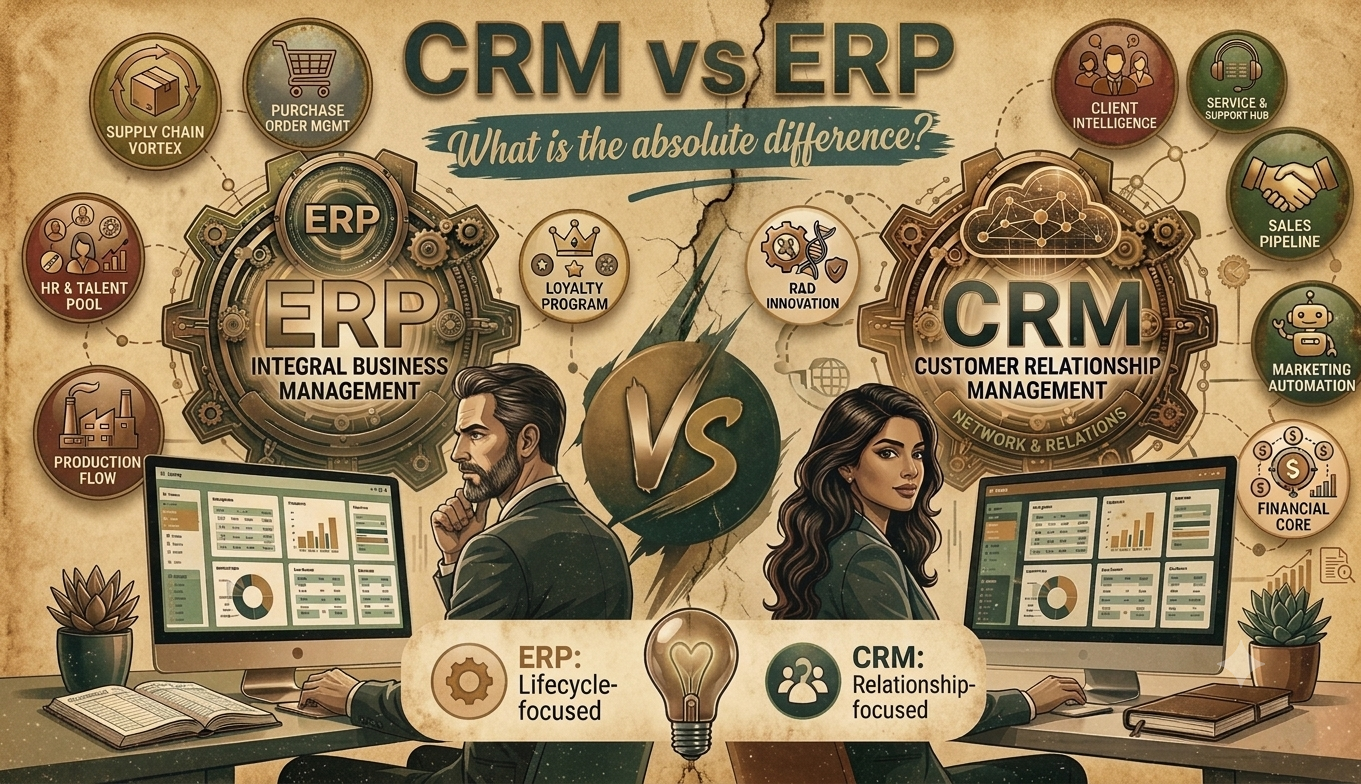
ERP vs CRM System solve different problems and are not direct competitors. CRM (Customer Relationship Management) software manages sales pipelines, leads, and customer interactions. ERP (Enterprise Resource Planning) manages your entire business — finance, inventory, HR, procurement, and projects — and typically includes CRM as one of its modules. A business needs CRM alone only if sales tracking is its single operational gap. A business needs ERP — which includes CRM — if it also manages inventory, accounting, payroll, or multi-department operations. RealSoft ERP includes a native CRM module, so UAE businesses don’t have to choose between the two.
“ERP vs CRM” is one of the most consistently searched comparisons in business software — and most articles that answer it give you a generic, global explanation with no actual decision-making help. Here’s the direct version, with the UAE business context that actually matters for your choice.
CRM (Customer Relationship Management)
An integrated platform that unifies CRM, inventory, sales, procurement, finance, and logistics for companies that buy and resell physical goods — eliminating the data silos created by using separate accounting, inventory, and CRM tools.
ERP (Enterprise Resource Planning)
An integrated platform that unifies CRM, inventory, sales, procurement, finance, and logistics for companies that buy and resell physical goods — eliminating the data silos created by using separate accounting, inventory, and CRM tools.
ERP vs CRM System : What Each System Actually Manages
Function | CRM Only | ERP (Includes CRM) |
|---|---|---|
Lead & pipeline tracking | ✓ | ✓ |
Customer communication history | ✓ | ✓ |
Inventory & stock management | ✗ | ✓ |
Accounting & VAT compliance | ✗ | ✓ |
HR & WPS payroll | ✗ | ✓ |
Purchase order & procurement | ✗ | ✓ |
Project & job costing | ✗ | ✓ |
Single data source across departments | ⚠ Sales only | ✓ Company-wide |
When You Need CRM Only — Not ERP
If your business is purely service-based with no physical inventory, no complex payroll structure, and your only operational gap is disorganized sales tracking — a standalone CRM may be sufficient. This applies to small consultancies, single-person agencies, or early-stage businesses where finance is handled by a simple accounting tool and sales is the only process that needs structure.
When You Need ERP (With Built-In CRM)
The moment your business manages physical stock, employs more than a handful of staff requiring WPS payroll, runs multiple projects with separate cost tracking, or needs VAT and Corporate Tax compliance beyond basic bookkeeping — a standalone CRM becomes a data silo, not a solution. You end up manually re-entering customer and order data between your CRM and your accounting system, which is exactly the disconnected-systems problem ERPs exist to solve. RealSoft ERP includes a native CRM module covering lead management, sales pipeline tracking, and customer interaction history — fully connected to inventory, invoicing, and finance, so a quote a salesperson sends becomes a sales order, then a delivery, then an invoice, without re-entry at any stage.
The Hidden Cost of Running CRM and ERP as Separate Systems
Many UAE businesses start with a standalone CRM because it’s quick to set up and inexpensive. The problem appears later — usually around the 18–24 month mark, once the sales team has built genuine pipeline discipline but the rest of the business hasn’t kept pace. At that point, a deal closed in the CRM still has to be manually re-typed into the accounting system as an invoice. Inventory teams have no visibility into what’s about to be sold, so they can’t plan procurement. Finance has no idea what revenue is actually committed versus just forecasted in the CRM. This isn’t a hypothetical risk — it’s the single most common reason mid-sized UAE businesses end up migrating from a standalone CRM to a full ERP, and the migration itself becomes more disruptive the longer it’s delayed, simply because more historical data has to be reconciled between two disconnected systems.
A Practical Example: How the Workflow Differs
Consider a UAE distribution company quoting a new client. With a standalone CRM, the sales rep logs the opportunity and sends a quote — but has no real-time visibility into actual stock levels, so the quote is based on guesswork or a phone call to the warehouse. Once the deal closes, someone manually creates an invoice in a separate accounting tool, often days later, introducing a lag between the sale and the financial record. With RealSoft ERP’s integrated CRM, the same sales rep sees live stock availability while building the quote, confirms the order against real inventory, and the system automatically generates the sales order, reserves stock, and prepares the VAT-compliant invoice — all from one action, with zero manual re-entry. This is the practical difference between “software that tracks sales” and “software that runs the business.”
A Practical Example: How the Workflow Differs ERP vs CRM System
Your Situation | Recommendation |
|---|---|
Pure services business, no inventory, <10 staff | ⚠ CRM may be sufficient |
You manage stock, products, or physical goods | ✓ ERP required |
You have 10+ employees needing payroll compliance | ✓ ERP required |
Revenue above AED 375,000 (Corporate Tax liable) | ✓ ERP required |
You’re re-entering data between sales and accounting tools today | ✓ ERP required |
Frequently Asked Questions
Is ERP better than CRM?
Neither is universally “better” — they solve different problems. CRM manages sales and customer relationships only. ERP manages the entire business, including sales (via a built-in CRM module), inventory, finance, HR, and procurement. Most growing UAE businesses need ERP because it includes CRM functionality plus everything else.
Does RealSoft ERP include a CRM module?
Yes. RealSoft ERP includes a native CRM module for lead management, sales pipeline tracking, and customer interaction history, fully integrated with inventory and finance — meaning sales quotes flow directly into orders, invoices, and stock updates without manual re-entry.
Can I upgrade from a standalone CRM to a full ERP later?
Yes. Coral Business Solutions supports migration from standalone CRM systems to RealSoft ERP, including data migration of existing customer and lead records into the new integrated platform.
Find the Right Fit for Your Business
Whether you need a CRM, an ERP, or a clearer understanding of the difference, our team can help.