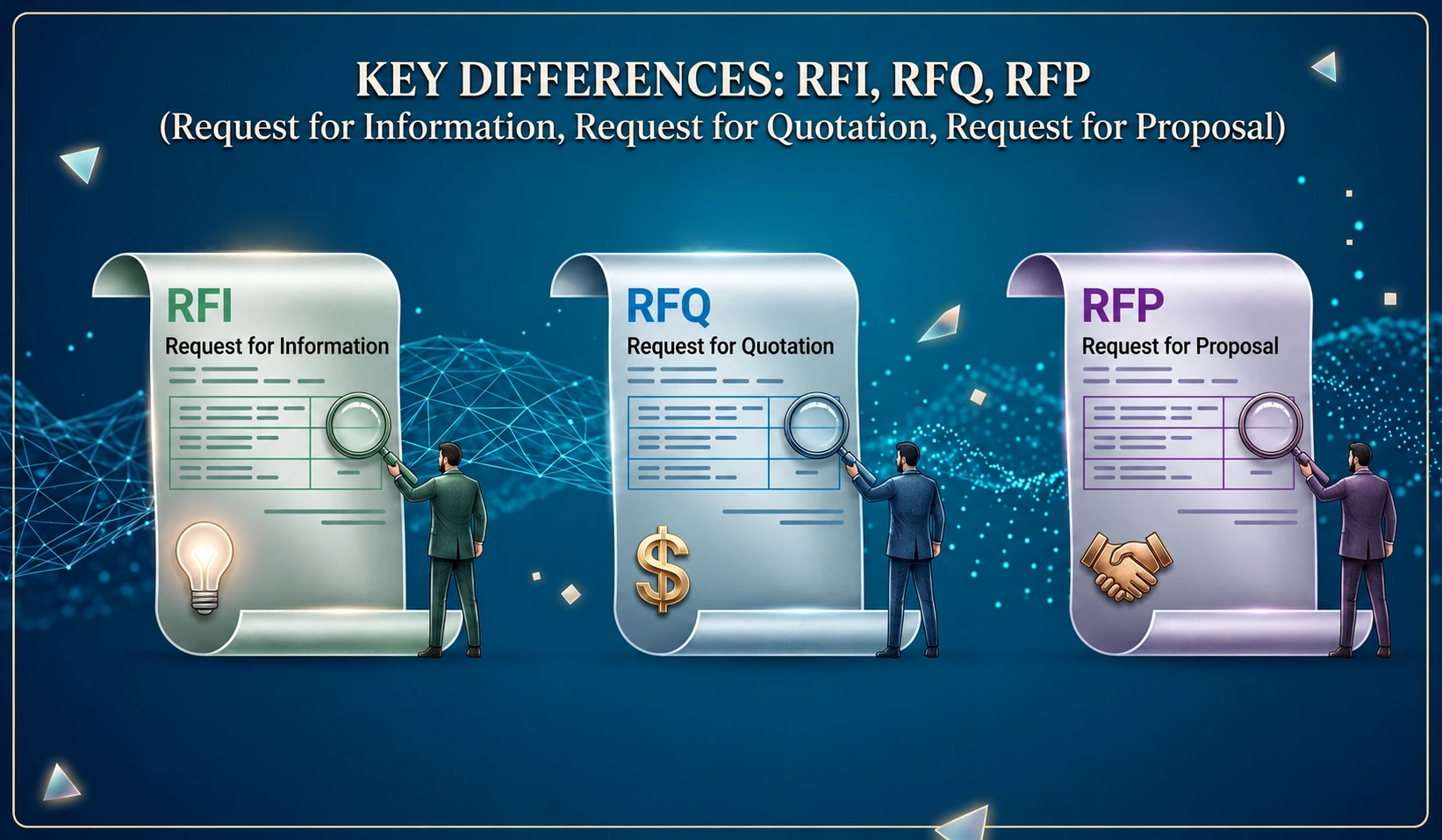
RFP vs RFQ vs RFI confusion sinks more UAE contractor bids than bad pricing ever does. All four documents — RFI, RFQ, RFP, and tender — live in the same family: a client wants something from suppliers before they commit to buying. But each one is asking for a fundamentally different response, and answering with the wrong one doesn’t just look sloppy — it can knock you out of contention before anyone even looks at your numbers.
Here’s the decoder, built around what each document actually demands from you — not the textbook definition nobody has time to read mid-bid.
Request for Information
SCREENING STAGERequest for Quotation
PRICE COMPARISONRequest for Proposal
APPROACH & METHODOLOGYTender / Invitation to Tender
BINDING BIDThe Comparison at a Glance RFP vs RFQ vs RFI
Document | Primary Ask | Price Required? | Room to Stand Out |
|---|---|---|---|
RFI | Capability & experience | No | Low — it’s just a screen |
RFQ | Price against fixed spec | Yes, firm | Very low — price wins |
RFP | Proposed approach | Yes, with reasoning | High — methodology matters |
Tender | Priced BOQ, compliance | Yes, binding | Low — price and paperwork decide |
The Mistake That Costs the Most Bids
Misread Brief
Answering an RFP like it’s an RFQ — a bare number with no proposed approach attached — is the single most common error UAE contractors make, and it’s an easy trap to fall into when your team’s juggling five bids at once. The client asked “how would you solve this,” and you handed back “here’s a figure.” That reads as either a misread brief or genuine indifference, and it loses winnable bids that a slower, more tailored response would’ve taken.
The reverse mistake burns you too — treating a plain RFQ like it deserves a full proposal wastes hours on a decision the client already told you comes down to price.
A Practical Checklist Before You Hit Send
01
Figure out which of the four you’ve actually received.
The subject line isn’t always accurate; read what’s actually being asked for, not what it’s labeled.
02
Match your response to the ask, not to your default template.
An RFP earns a tailored technical story; an RFQ earns a fast, accurate price.
03
Track submission requirements per bid type.
Tenders often carry bond and guarantee requirements RFPs simply don’t, and missing one is an instant disqualification, price be damned.
04
Keep a live record of where every opportunity stands.
RFI shortlisting, RFP evaluation, tender submission — so nothing slips through because it looked like just another procurement email in a crowded inbox.
Frequently Asked Questions
Is an RFQ the same as a tender?
Close, not identical. Both are price-driven, but tenders — especially UAE government and large construction contracts — usually carry heavier compliance, bonding, and BOQ requirements than a standard RFQ.
Can an RFI turn into an RFP without a separate RFQ stage?
Yes — all three don’t always show up in one procurement process. An RFI often flows straight into whichever of RFP or RFQ fits how the client actually wants to decide: proposed approach, or straight price comparison.
What’s the clearest sign a proposal team misjudged the request type?
A response that’s all price with no approach for what was actually an RFP — or one that’s heavy on methodology and light on a firm number for what was really a plain RFQ.
Track Every RFI, RFQ, RFP & Tender in One Place
RealSoft keeps every opportunity — shortlisting, evaluation, submission — visible in one live pipeline, so nothing slips through a crowded inbox.